





This short guide gives Indian teams a practical, execution-first walkthrough that links Ahrefs insights to real-world SEO workflows.
We start with the model context protocol basics and move to architecture and safe integrations. Then we cover 15 Ahrefs-centric MCP use cases, followed by automation patterns, reporting controls, and risk checks.
Think of the protocol as a bridge between large language models and your tools and systems. That bridge helps marketers act on data instead of only reading recommendations.
The promise is simple: faster cycles, fewer manual handoffs, and fewer copy/paste steps across research, briefs, reporting, and ticketing. This is tailored for in-house SEO teams, agency strategists, performance marketers, and founders in India who manage multilingual and multi-location SERPs.
Each example follows a repeatable pattern: live context in, reasoning, tool calls out, and measurable feedback loops. We also preview how to pick safer mcp servers, budget token costs, and spot where this protocol is truly worth the effort today.
Key Takeaways
- This guide ties Ahrefs data to actionable workflows for Indian SEO teams.
- You’ll get a clear pattern: context, reasoning, action, and feedback.
- Expect faster delivery, fewer handoffs, and less manual copying.
- We explain architecture, safe mcp servers, and cost trade-offs.
- Use the checklist to decide when the protocol adds real value today.
What the Model Context Protocol is and why it matters for SEO today
Think of the model context protocol as a standardized connector that keeps language models tied to fresh SEO data and tools. It defines a common interface to feed live signals into an llm instead of relying on baked-in memory.
MCP as an open standard for connecting LLMs to tools, data, and systems
The protocol works like USB‑C for AI apps: one port, many integrations. An AI client can call external tools and data sources via a predictable API. That avoids one-off connectors for every marketing platform.
Why models are only as good as the context provided
SEO realities shift daily—rankings, SERP layouts, and competitor pages change. Models given stale information will suggest wrong fixes, from outdated canonical rules to old Core Web Vitals advice.
How real-time context reduces hallucinations
Supplying current crawl outputs, live rank snapshots, and site templates anchors recommendations in fact. That lowers hallucinations and reduces wasted technical fixes, needless rewrites, and misleading reports.
| Approach | Source of truth | Typical outcome |
|---|---|---|
| Static model memory | Pretrained weights | Stale suggestions; higher error rate |
| Model context protocol | Real-time tools & data | Accurate, actionable recommendations |
| Hybrid (cached + live) | Cached data + periodic updates | Balanced cost and freshness |
How Ahrefs MCP fits into modern search and content workflows in India
Indian SEO teams juggle multiple tools, and that split costs real time every week. Research in Ahrefs, separate rank trackers, planning in Google Sheets, briefs in Docs or Notion, and reports in Slides create repeated formatting and handoffs.
Typical friction: hours spent copying metrics, reformatting tables, and turning insights into tasks for writers, developers, and outreach teams. That delays delivery and reduces focus on strategy.
What changes with MCP: once context and live data are retrieved, the assistant can call integrations and apis to draft briefs, open tickets, publish drafts, and send stakeholder updates. This shifts teams from analysis-only work to analysis + action.
- City-level landing expansions for multi-location brands.
- Bilingual planning in Hindi and English for local search.
- Rapid competitor tracking in crowded spaces like fintech and edtech.
One prompt can pull Ahrefs metrics, draft a brief, create a ticket, and notify stakeholders as an orchestrated workflow. Execution needs scoped permissions and vendor-certified mcp servers to keep control over what changes and who approves them.
Next: marketers should understand architecture to pick safe, scalable setups and balance token costs with response speed.
MCP architecture overview for marketers
A clear architecture helps marketers map who asks for data, who routes requests, and who executes actions.
MCP client vs host vs server
Client: the chat or assistant interface your team opens to ask questions and start workflows. It is the daily entry point for analysts and writers.
Host: the orchestrator that routes requests, manages scaling and logs, and enforces policies across environments. This is the control plane that keeps enterprises audit-ready.
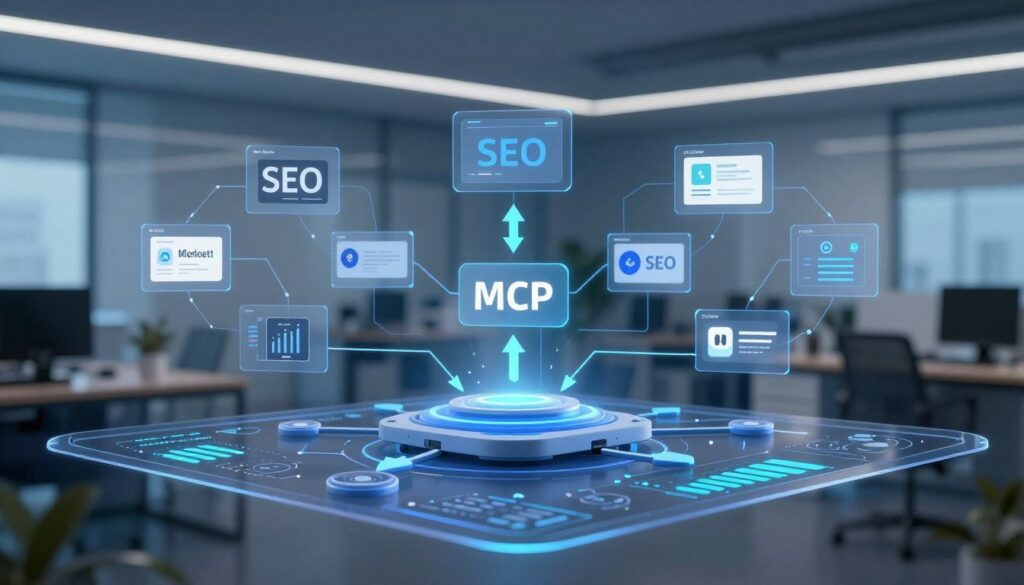
Server: the connector that safely exposes tools, resources, and prompts. Servers let the model call a SERP pull, a brief template, or a publish-to-CMS tool without hardcoding.
Reusable components, discovery, and costs
Build components like a content-brief prompt, a SERP resource, and a publish tool once and reuse them across brands.
- Capabilities discovery: the client asks the server what agents and tools exist, then adapts UI workflows.
- Context windows: large crawls or long briefs can overflow the model, so summarize and scope retrieval.
- Token budgeting: extra metadata and live context raise token counts and monthly spend—plan for this operationally.
Mental model: discovery → retrieve context → call tools → write outputs → log actions. This pattern keeps work repeatable and auditable for Indian marketing teams.
Choosing MCP servers and integrations that are safe and scalable
Before you let an assistant act, decide which servers can be trusted to run tasks and handle data. Security and clear access controls should guide every integration choice for Indian teams managing multiple brands and locales.
Vendor-certified vs community servers
What to verify before connecting
Check who maintains the server, how updates are shipped, and whether it is vendor-certified or independently audited. Confirm the actual tool list and what each tool can perform, especially any write or publish actions.
Why community servers can be risky
Practical risks
Community servers sometimes request broad permissions and may be poorly maintained. That matters when a server can execute actions, rotate keys, or expose unexpected tools to users.
Authentication patterns for marketers
OAuth, API keys, and sessions
Use OAuth for SaaS integrations, API keys for data providers, and session-based access for internal systems. Plan secret rotation and logging so access management stays operationally simple.
Scope segregation and permission control
Designing least-privilege teams
Segregate by client or brand: agencies need client-by-client separation while in-house teams should enforce business-unit scopes. Give read-only access for research, limited write for task creation, and approval steps for any publish action.
Checklist for safe mcp servers
- Maintenance owner and update cadence
- Vendor certification or audit reports
- Explicit tool list and allowed actions
- Authentication methods and secret rotation plan
- Scope segregation model and approval workflows
- Mapping integrations and apis to clear business outcomes
MCP use cases for SEO and digital marketing with Ahrefs
Here are targeted workflows that pair Ahrefs insights with automated agents to shorten execution cycles. Each example ties live site signals and Ahrefs metrics to actions that teams in India can run and audit.
Technical SEO audits grounded in live data
How it works: an agent pulls crawl outputs, indexability flags, and template patterns, then returns prioritized fixes mapped to real site sections.
Keyword research and clustering
Context-aware clustering uses Ahrefs metrics plus site taxonomy to build intent groups. This makes target lists practical for local SERPs.
Competitor gap analysis and briefs
Automated comparison of pages, keywords, and link profiles produces a ranked “what to build next” list and brief drafts for writers.
- Internal linking: suggestions based on hubs, priority URLs, and crawl depth.
- Backlink prospecting: CRM-style enrichment with contact paths and pitch notes.
- Link risk review: standardized rules for toxicity and sudden spikes.
Orchestration and reporting
The same agents can create tasks, update tickets, and generate role-based reports so execution follows a single, auditable prompt.
End-to-end automation patterns: turning prompts into repeatable workflows
End-to-end automation ties data, decisions, and actions into a single repeatable flow for marketing teams. This is the marketer’s dream state: one workflow reads Ahrefs metrics, updates a PM platform, notifies Slack, and refreshes reporting artifacts.
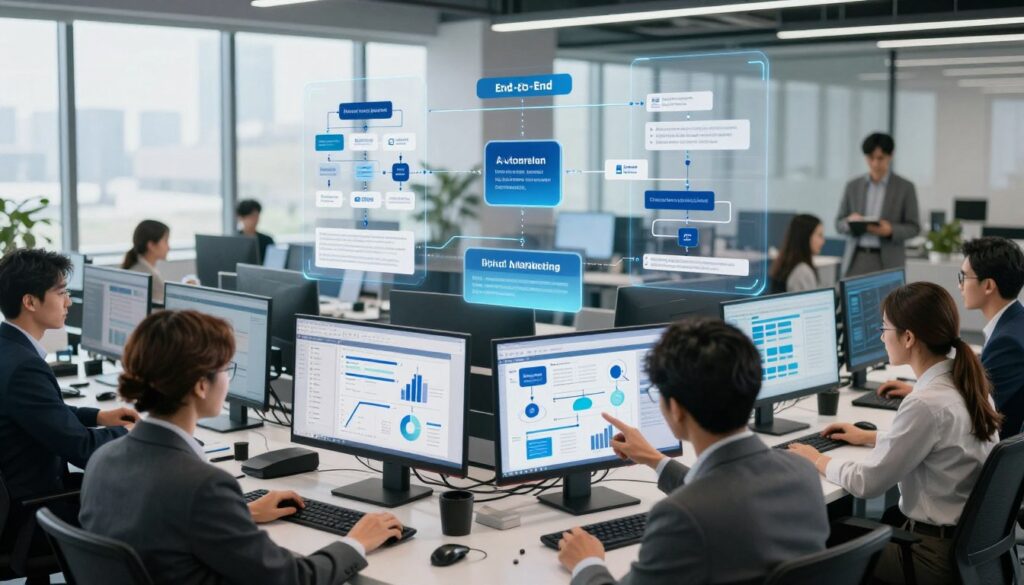
Unified data and action management across platforms, services, and applications
Unified management reduces handoffs. An agent fetches live data, maps it to project fields, and then triggers the next step. Each tool call becomes a logged unit of work: fetch → analyze → draft → create tasks → publish → notify.
Reusable prompt templates for consistent outputs and brand voice
Keep prompts as version-controlled assets. Templates for briefs, audits, and monthly narratives lock in tone, approved claims, and SEO QA checks.
“Versioned prompts are operational assets — they make outputs predictable across teams and regions.”
Closed-loop execution: measure results, update systems, and iterate
Agents should not stop at reporting. After publishing, an automated check measures rankings and traffic, updates project status, and recommends the next iteration.
- Start small: build a weekly SEO health-check workflow first.
- Log every request and response for auditability.
- Tie templates to brand governance to keep voice and compliance consistent.
- Scale by turning common tool calls into reusable modules across platforms and applications.
Practical outcome: fewer tabs, faster handoffs, and a better experience for writers, devs, and managers in India.
Using MCP for reporting, forecasting, and budget guardrails in marketing operations
Reporting and forecasts must be automated so teams spend time on decisions, not spreadsheet wrangling. An integrated approach ties live site signals and Ahrefs metrics to slide-ready narratives and channel-level appendices.
Automated anomaly detection and narrative summaries
Agents scan ranking drops, traffic spikes, crawl errors, and backlink velocity shifts. When an anomaly appears, the system drafts a concise narrative suitable for weekly or monthly decks.
Scenario modeling and campaign trade-offs
Run “what-if” models: publish X pages per month and see expected traffic ranges. Each scenario lists assumptions and uncertainty so stakeholders judge risk and reward.
Governance, attribution, and budget guardrails
Track which workflows and tools were invoked, who ran them, and what requests produced which responses. Log versions of prompts and maintain approval gates for publishing or config changes.
- Budget guardrails: set token thresholds, schedule expensive runs, require approvals for high-impact actions.
- Operational example: festive-season forecasts for Indian retailers and multilingual rollouts with cost caps.
| Output | Audience | Format |
|---|---|---|
| Slide summary | Leadership | 1 slide |
| Appendix detail | Channel owners | Analyst notes |
| Audit log | Ops | CSV/JSON |
Security, compliance, and risk management for MCP in real organizations
Security must be at the center of any automation that can act on your content, data, or publishing systems. Teams should plan controls before enabling connectors that hold tokens or can publish changes.
Prompt injection and tool impersonation
Prompt injection happens when malicious inputs in pages, tickets, or documents try to trick the model into leaking sensitive information or calling a tool it should not. Treat external content as hostile by default.
Tool impersonation is when a misconfigured or rogue integration pretends to be trusted. That can let attackers exfiltrate data or perform unauthorized actions under a familiar name.
Token theft, session hijack, and the “keys to the kingdom”
If OAuth tokens or API keys are exposed, attackers can replay sessions or spin rogue server instances. A compromised server that stores many credentials can cascade access across email, analytics, CMS, and storage.
Real-world caution: CVE-2025-49596 (RCE in Anthropic’s MCP Inspector) shows why patching and vendor review matter.
Operational controls to reduce risk
- Enforce least-privilege roles and narrow scopes for every integration.
- Require approvals for write or publish actions and keep a human-in-the-loop for sensitive flows.
- Centralize logging of tool calls and audit them regularly.
- Rotate keys, run periodic access reviews, and maintain vendor due diligence for compliance with client confidentiality.
| Risk | Impact | Mitigation |
|---|---|---|
| Prompt injection | Data leaks, wrong actions | Sanitize inputs; treat external text as untrusted |
| Tool impersonation | Unauthorized operations | Verify tool identities; limit allowed tools |
| Token/session theft | Cross-system compromise | Rotate keys; short-lived tokens; session monitoring |
Common drawbacks and practical constraints when implementing MCP
Practical rollouts expose gaps between a protocol’s promise and the maintenance it demands. Teams should plan for steady engineering and operational effort beyond the initial setup.
Integration overhead and maintenance realities
Even with a standard, each integration needs configuration, monitoring, and updates. When Ahrefs exports change, CMS endpoints shift, or reporting schemas evolve, workflows break and must be fixed.
Latency vs cost trade-offs
Pulling real-time context across many tools increases response time and token costs. Design performance budgets so expensive fetches run on schedules, not every request.
Why the protocol is not a replacement for existing platforms
The model context approach complements—and does not replace—your APIs, ETL, or iPaaS. Keep stable pipelines for heavy data movement and use the protocol for natural-language orchestration and action.
“Treat the protocol as an orchestration layer, not a one-stop integration platform.”
- Scope large audits to avoid context window limits.
- Assign ownership for connectors and prompt templates.
- Use the protocol where human-like orchestration adds value; keep batch jobs in existing systems.
| Constraint | Impact | Practical mitigation |
|---|---|---|
| Context window limits | Truncated inputs on long audits | Chunk, summarize, or paginate crawls |
| Auth & token rotation | Expired keys; failures | Short-lived tokens; regular rotation |
| Latency & cost | Slower responses; higher spend | Cache noncritical data; schedule heavy runs |
Conclusion
Connect Ahrefs insights to action and you get real returns: faster execution, clearer handoffs, and measurable impact. The model context protocol improves outcomes because agents operate on live model context rather than static memory, which cuts down hallucinations and bad fixes.
Start small: run an audit‑to‑ticket workflow, auto‑generate briefs, and schedule a weekly report. Those three workflows prove value before scaling automation across teams.
Operationally, pick vetted mcp servers, enforce scoped access, log every tool call, and treat prompts as reusable assets. This keeps the system auditable and the experience predictable for India‑focused teams tackling multilingual, multi‑location SERPs today.
Measure results, iterate often, and keep humans as the final approval gate so the system stays useful and trustworthy.