







Short cuts often look attractive, but they can mislead teams. The idea that slicing long pieces into neat parts will automatically boost visibility is popular. Yet Semrush data and AI-driven search trends show passage-level results and AI Overviews are changing how content is found and cited.
For Indian SEOs, product leads, and growth teams, visibility now means more than rank. It includes citations, AI Overviews, and conversational answers that drive higher conversions. Smart teams must decide when chunking improves retrieval and when it fragments meaning.
This guide offers a practical, evidence-led view. You will learn why passage-level processing made chunking popular and why shallow hacks fail. Expect clear advice on testing, measuring CTR and engagement, and focusing on substance over format.
Key Takeaways
- Chunking helps retrieval, but it is not a substitute for authority and quality.
- Passage-level results and AI Overviews change how information is cited in search.
- Indian teams should prioritize citation accuracy and user outcomes, not just ranks.
- Test chunk strategies: measure CTR, engagement, and citation correctness.
- Focus on clear structure and factual content to avoid context loss.
Why “chunk optimisation” suddenly feels like the new SEO hack
Search results are shifting toward precise, citation-ready lines of text. That change explains why teams rushed to break pages into short, quoteable parts. Semrush reports AI Overviews now appear in ~13% of Google searches and doubled in two months. AI-driven search evaluates pages at the passage level and pulls the most relevant lines to cite.
When a cited passage becomes the first touchpoint, conversion math changes. AI-sourced users convert about 4.4× higher than traditional organic visitors. So, pages that are easy to cite show better performance even if they do not hold the top rank.
The visible nature of passage retrieval creates a trap. People begin treating tight, standalone text like a density game. That makes teams chase short wins instead of meaning and intent.
How passage-level retrieval reshapes competition
Passage retrieval shifts the fight from the best page to the best passage. Clear boundaries, concise claims, and self-contained explanations increase the chance a system will extract and cite your text.
| Factor | Why it matters | India relevance |
|---|---|---|
| Concise sections | Higher citation likelihood | Mobile readers prefer quick answers |
| Unambiguous claims | Less extraction error by AI | Multilingual audiences need clarity |
| Scannable structure | Improves retrieval and CTR | High-intent queries convert faster |
Next, we will separate useful, meaning-driven sectioning from superficial formatting tweaks so teams stop mistaking style for substance.
What content chunking actually is and what it is not
Good web content breaks ideas into self-contained answers that both users and models can reuse.
Definition: In web terms, content chunking is dividing material into semantically complete units. Each unit is a self-contained piece of text that can be extracted without losing meaning. A true chunk answers a query, not just decorates a page.
What makes a useful standalone unit:
- Explicit subject and minimal pronouns so the meaning stays clear.
- Tight scope with a direct why/what/how payoff.
- Clear logical boundaries so the unit does not rely on prior sentences.
Chunking vs. formatting: Headings, lists, schema, and anchors help navigation, but they are not a substitute for semantic independence. Formatting aids interpretation. Real value comes when the structure reflects intent and information, not only style.
“This improves performance…” → Bad chunk (unclear referent). Rewrite: “Reducing image size improves page load time and mobile UX.” → Good chunk.
Why boundaries matter: Systems score and retrieve passages by how clearly they hold a claim. Logical boundaries beat token-perfect splits when the goal is accurate citations and summaries. Schema and anchors increase discoverability, but they complement—not replace—the method of creating independent sections.
How AI-driven search processes your page at the passage level
AI systems now judge individual paragraphs as standalone answers, changing what wins in search.
The retrieval process breaks pages into small, scoreable units. Each section can be evaluated and cited independently of the page’s overall rank.
Why unclear section boundaries reduce confidence and citations
When sections mix topics or wander, systems lower their extraction confidence. A wandering section forces a model to add context before it can answer a query.
How query intent maps to sections, not pages
One page can satisfy multiple queries only if each intent has a labeled, self-contained section. Clear headings and short, focused paragraphs give lexical cues that reduce extraction risk.
“If a passage cannot be quoted alone without extra context, systems rarely select it for summaries.”
- Systems score relevance using headings, semantic similarity, and clarity signals.
- A diagnostic rule: if you must prepend or append sentences to make a quote sensible, the passage will likely lose citations.
- Design sections to be interpretable, not fragmented for the sake of format.
| Signal | What it shows | Publisher action |
|---|---|---|
| Heading clarity | Lexical match to queries | Use descriptive headings and question-style titles |
| Semantic similarity | Concept match to intent | Keep examples and definitions aligned to queries |
| Quotability | Low extraction risk | Write self-contained sentences that answer one question |
Chunk optimisation critique: where the SEO advice gets overstated
When packaging replaces research, sites lose authority even if they gain short-term visibility.
Neat sections can look like progress, but they do not guarantee quality. Teams often focus on measurable edits instead of original reporting, firsthand examples, or citations. That creates an appearance of depth without real substance.
When short sections become a proxy for “good content” and fail
Editors equate counted headings and short paragraphs with results. This proxy problem rewards formatting over insight.
“Optimising visible snippets is helpful, but it does not substitute for expert input or primary data.”
How over-chunking can dilute authority and fragment context
Too many micro-sections make pages feel repetitive. Readers and systems see isolated fragments instead of a coherent argument. That reduces perceived authority and practical value.
What this approach cannot fix: weak E-E-A-T and shallow information
Short sections will not hide missing author credentials, citations, or original examples. A sound strategy pairs readable structure with clear expertise.

| Failure mode | Why it matters | Fix |
|---|---|---|
| Proxy metrics | Teams measure headings, not research | Prioritize expert review and case studies |
| Fragmentation | Context lost between micro-sections | Group related points and add summaries |
| Shallow FAQs | Repeatable, generic information | Localize examples and add constraints |
Standard: each section must earn its space with substance, not just structure. That is the practical approach to real, lasting results.
The hidden trade-offs: context loss, “lost-in-the-middle,” and boundary errors
Splitting text for retrieval often creates subtle gaps that models and users notice.
Lost-in-the-middle means an answer exists on the page but is buried in a long section so systems underweight it. Search models scan and score passages; if the signal sits deep inside a long block, relevance can drop.
Pronouns break embeddings fast. A chunk that starts with “Its benefits…” fails if the entity appears only in the previous section. That anaphora error reduces embedding quality and lowers retrieval accuracy.
Lessons from RAG matter for publishing. Early splitting before creating embeddings severs cross-section links. Late token-level embedding preserves full context but raises cost and is not always supported by APIs.
Bigger chunk size can carry more context, yet it also adds noise, slows performance, and raises compute and storage cost. Optimal tokens do not equal optimal meaning—arbitrary splits can cut definitions or causal chains.
- Repeat nouns near boundaries.
- Restate the subject in the first line of a section.
- Avoid dangling references like “this” or “it”.
“More structure is useful, but without care for context and references, visibility gains will be fragile.”
When chunking truly helps SEO and AI visibility
Targeted, self-contained passages raise the odds that systems and users find the right answer fast. Properly divided content improves passage-level relevance and makes it easier for models to select and cite material with confidence.
Improving passage relevance for specific queries and search
Works best for multi-intent guides, product docs, and comparison posts. When a section answers a narrow question directly, retrieval becomes more reliable and the passage can appear in featured citations.
Use short definitional paragraphs, step lists, and Q&A blocks that mirror real queries to increase match rates.
Reducing misinterpretation in AI citations and summaries
Write standalone sentences that avoid pronouns and vague references. Clear anchors cut the chance of incorrect summaries and protect brand accuracy when third-party systems republish your text.
Indexing and crawl efficiency gains from cleaner structure
Logical headings and predictable sections help crawlers parse pages faster and index the right fragments. Better structure reduces parsing ambiguity and improves how search bots rate relevance.
| Benefit | Why it matters | Publisher action |
|---|---|---|
| Passage relevance | Higher citation likelihood | Align headings to queries |
| Accuracy | Fewer misquotes by models | Use explicit subjects and short examples |
| Indexing | Faster, cleaner crawl | Use predictable hierarchies and anchors |
Practical example for India: A “GST invoice requirements” guide benefits from a checklist section that answers compliance queries, plus deeper context sections for edge cases. That balance favors retrieval while keeping authoritative content intact.
“The goal is not maximum fragmentation but maximum interpretability and usefulness.”
Picking the right chunking strategy for your content and queries
Match your splitting approach to the reader’s task and the query signal. Start by mapping content type to a clear decision rule so teams do not copy tactics blindly.
Decision framework: For blogs and landing pages, prefer section-based patterns. For knowledge bases, use fixed-size or semantic splits. For product docs, favour mixed-granularity so skimmers and experts both win.
Fixed-size chunking for speed and predictable operations
Use fixed-size as a baseline. It is fast, scalable, and simple to deploy across many documents. Treat it as the operational default before iterating.
Semantic chunking for topic shifts and coherence
Split where topics change. This preserves meaning and helps systems pick coherent passages for citation.
Section-based chunking using headings and FAQs
Use templates and consistent headings. That helps readers and search systems navigate reliably and improves retrieval match rates.
Mixed-granularity and contextual approaches
Offer quick answers and deeper explains on the same page. Prepend a short document-level context when pronouns or cross-references are common; experiments show 2–18% retrieval gains but add storage cost.
Late chunking when token-level embeddings are available
Embed first, then pool to keep reference chains intact. This can lift accuracy ~10–12% on pronoun-heavy documents, but it costs more in compute and complexity.
“Choose a plan that balances cost, accuracy, and the content type you serve.”
How to choose chunk size, overlap, and retrieval windows without guessing
Pick chunk sizes by balancing precise answers with enough surrounding text to keep meaning intact.
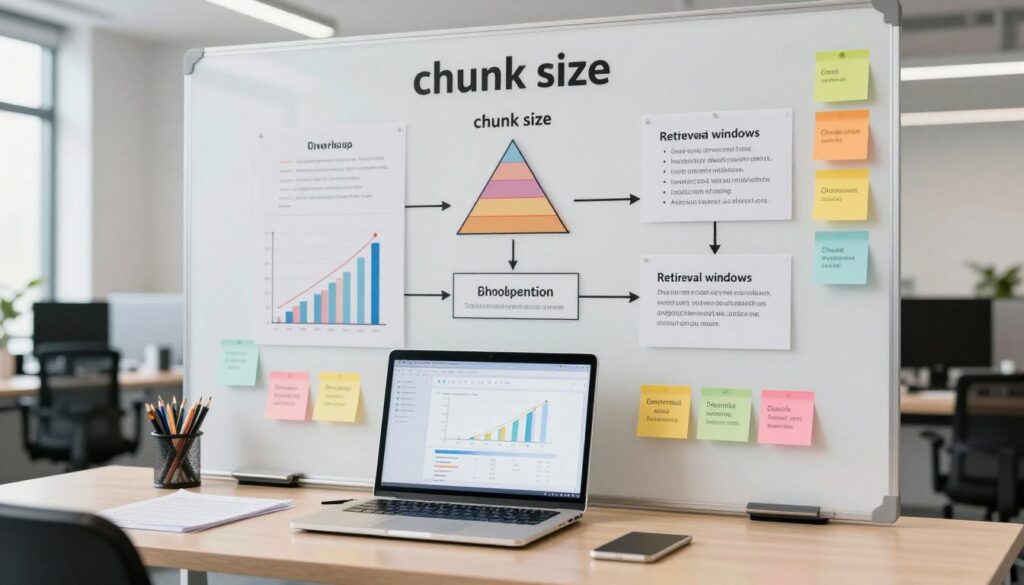
Start with a practical window: 100–500 tokens per unit. This range often balances tight relevance for narrow queries and enough context to avoid missing prerequisites.
Why 100–500 tokens works
Smaller token counts help retrieval systems match short queries. Larger token groups reduce the risk of half-answers when a definition needs nearby explanation.
When to use overlap
Small overlap helps when answers straddle boundaries, for example a definition plus constraints. Keep overlap minimal to avoid bloating storage and repeated noise.
Retrieval windows and query-time expansion
Retrieve the top-matching unit, then pull 1–2 adjacent units as a window for generation. This restores missing context without indexing huge blocks.
“Test for success: better citation accuracy, improved engagement, and fewer misleading summaries—not just more fragments.”
| Decision | Rule of thumb | Impact |
|---|---|---|
| Initial token range | 100–500 tokens | Balance precision and context |
| Overlap | 5–15% of unit length when needed | Fixes boundary split answers, raises storage |
| Retrieval window | Top match + 1–2 neighbors | Recovers context for generation |
| Testing metric | Citation accuracy & engagement | Measures true performance gains |
Example: a “How to audit chunking” query returns a checklist unit, then expands to include nearby tool recommendations and pitfalls. For large Indian sites, prefer minimal overlap and rely on query-time expansion to control infra cost.
How to structure pages for humans and AI search together
Design pages so a person and a model can understand the same passage without extra context.
Write standalone but natural sections. Start a section with the topic noun, give a short definition, then answer the question concisely. End with any constraints or quick examples. This keeps the language clear for readers and quotable for search.
Use varied sentence openings to avoid a robotic tone. Repeat the entity once near the start, then use pronouns sparingly. That balance keeps the section extractable and readable.
Formats that win citations
Q&A blocks, short lists, and tight paragraphs under descriptive headings consistently perform well. They match real user questions and reduce ambiguity for AI extractors.
- Q&A: Phrase the question as users ask it, then answer in one or two sentences.
- Lists: Use numbered steps or bullets for processes and benefits.
- Concise paragraphs: One idea per paragraph; avoid extra qualifiers.
Metadata, schema, and internal anchors
Apply structured data: FAQPage for question sets, Article for long pieces, BreadcrumbList for navigation, and author markup to show ownership. Add a clear table of contents and jump links so each section is discoverable.
- Map common user questions to headings and anchors.
- Add meta descriptions that summarize the section’s answer in natural language.
- Use consistent heading hierarchy so crawlers and readers both find context quickly.
“One well-written section beats many tiny, unclear fragments.”
| Element | Why it helps | How to apply | Example |
|---|---|---|---|
| Q&A block | Matches user questions directly | Use question-form heading + 1–2 sentence answer | Q: What is GST due date? A: The monthly due date is the 20th… |
| Bulleted list | Shows steps or benefits clearly | Keep 3–6 concise items, start with verbs | 1. Prepare invoice 2. File return 3. Pay tax |
| Schema & anchors | Improves interpretation and discovery | FAQPage, Article, BreadcrumbList; add jump links | FAQ schema for compliance questions |
How to run a chunking audit on existing pages before you rewrite everything
Begin by exporting headings across documents to find weak boundaries and noisy text.
Start with a fast audit workflow: export headings, capture section lengths, and flag pages with unclear hierarchy. Use a crawl tool to pull titles and anchors; store the results as simple CSV for sampling.
Spot multi-topic sections by scanning for paragraphs that answer more than one question or mix definition with tactics. These mixed paragraphs confuse readers and lower extraction quality for AI systems.
Finding passages that depend on earlier context
Identify dependency passages by searching text for starters like “this,” “it,” “also,” or “therefore” that lack a named subject. Those lines fail as standalone answers when models extract quotes.
Fixes often avoid full rewrites. Add a clarifying first sentence, split the paragraph into two focused pieces, or prepend a one-line context so the passage reads alone.
- Check boundary integrity: ensure lists and steps stay connected to their explanations.
- Keep examples with the claims they illustrate; don’t let them sit across a section break.
- Prioritise pages with traffic or high-conversion queries first.
“A short, targeted edit on a high-impression document often beats blind rewrites across low-value pages.”
How to build a chunk optimization workflow that improves results over time
Build a workflow that treats section design as a repeatable content operation, not a one-off task. Make processes that map queries to sections, test outcomes, and limit cost for retrieval-augmented generation (RAG) use cases.
Start by mapping real user questions to page sections. Use Search Console, support tickets, sales calls, and site search logs to create a list of the exact questions each section must answer. This keeps the work focused on user needs.
Test strategies and measure meaningful performance
Run controlled experiments on a subset of pages. Track citations in AI features, CTR shifts, engagement (scroll depth and time), and answer accuracy via spot checks.
Balance quality with cost for RAG and LLM reuse
Set rules for unit size, overlap, and contextual prefixes so LLM generation calls remain predictable. Small contextual prefixes improve retrieval but add LLM calls and cost. Document limits and review spend monthly.
Iteration cadence and governance
Schedule quarterly audits for evergreen topics and faster refresh cycles for volatile SERPs. Assign clear ownership and publish a template for headings, definitions, and section patterns so new pages ship ready for retrieval.
“Treat this as content operations: map queries, test changes, measure results, and govern standards.”
- Operationalize: make section design part of regular content sprints.
- Test: A/B a few pages before rolling changes site-wide.
- Monitor: track citations, CTR, engagement, and accuracy.
- Govern: keep templates and ownership to prevent decay.
Conclusion
, Good sectioning lifts quoted lines into search features only when each unit states a clear claim and stands alone.
Summary: Use chunking to improve retrieval and citation, but avoid over-fragmenting. First, fix section boundaries so each chunk answers a single query and headings match real user language.
Remember: neat chunks do not fix weak expertise or thin information. Measure changes by citations, CTR, engagement, and manual checks for misinterpretation.
Adopt a repeatable size and style rule for documents so new pages remain interpretable as search models evolve. Finally, run a quick audit on your top pages and update the worst multi-topic sections before broad rewrites.