





This introduction lays out a practical, SEO-first playbook for improving how often your brand and content get referenced across modern answer engines and platforms.
Who this is for: SEOs, marketers, and site owners in India who compete in English SERPs and large language model outputs. Expect hands-on steps, not hype.
Search is changing. Brands are increasingly selected inside ai-generated answers, often without a click. This shifts the work from rank chasing to being chosen by answer systems.
What you will get: a clear meaning of the new discovery signals, how user behavior is shifting, which platforms matter most, and a repeatable optimization strategy that blends on-page structure, schema, and off-site authority.
By the end, you will baseline current presence, pick metrics that reflect AI discovery, and build a plan for sustainable growth based on measurable signals like mentions, citations, and share of voice.
Key Takeaways
- Understand how ai-powered search changes content selection and brand presence.
- Learn which platforms and engines matter for being cited in answers.
- Get actionable optimization steps: structure, schema, and authority.
- Measure success with mentions, citations, and share of voice, not just clicks.
- Build a strategy tailored for India-based teams competing globally.
What AI Visibility Means in the Era of AI-Powered Search
Modern answer systems now choose which sources to quote, not just list links.
Definition: For SEOs, visibility means two linked things: discoverability and references. Discoverability is crawlable, indexed content plus a healthy presence across the web. References are how often systems mention your brand and cite your content inside responses.
Different platforms use different retrieval methods, so presence varies by engine and platform. Monitor ChatGPT, Claude, Perplexity, Google AI Overviews, and Google AI Mode to see where you get cited.
Classic behavior in traditional search rewarded ranking in blue links. Selection in ai-powered search rewards being chosen inside fused answers, snippets, or cited lists.
Language models parse pages into chunks. A single paragraph or table can be selected even when the page does not top the SERPs.
Outputs vary between runs, so visibility is probabilistic. Track mentions, citations, and share of voice over time rather than relying on one-off checks.
Key concepts to track
- Mentions: named references to your brand.
- Citations: direct links or named sources included in responses.
- Share of voice: proportion of recommendations where you appear.
- Context & sentiment: how information about your brand is framed.
| Element | What to measure | Why it matters |
|---|---|---|
| Discoverability | Indexing status, crawl frequency | Prerequisite for being referenced |
| References | Mentions, citations in responses | Direct influence on impressions and trust |
| Variability | Response sampling over time | Shows probabilistic nature of selection |
Why AI Visibility Matters Now for Growth, Brand, and Traffic Quality
Brands now face a new gatekeeper that often decides who gets considered before any click happens. This changes the funnel: many people receive a direct answer or recommendation and never scan ten blue links.
Fewer clicks, higher intent
Short-form answers often remove basic research from the journey. That filters out “tire-kickers” and lifts the quality of incoming traffic.
Fewer visits can still mean stronger conversions because the remaining users are further along in intent.
Personalized recommendations and the one-winner risk
Some systems surface a single recommended product or provider. That compresses exposure compared with a SERP of ten options.
Brands must earn third-party mentions and structured authority to avoid being excluded from that single slot.
The “great decoupling”: impressions without clicks
Overview features raise impressions and brand mentions, but clicks may not rise proportionally. Marketers need new KPIs and narratives.
- Business case: being mentioned shapes consideration before a site visit.
- KPI shift: measure mentions, citations, and intent-weighted traffic.
- Budget impact: invest in content structure, PR, and technical optimization now.
| Metric | Old signal | New emphasis |
|---|---|---|
| Reach | Impressions | Mentions & citations |
| Engagement | Clicks | Intent-weighted traffic |
| Trust | Rank | Third-party validation |
“Mentions in answers shape brand perception just as much as a click-through does.”
How Users Search Differently with AI Answer Engines
People now pose whole scenarios and constraints in a single query, not just a pair of keywords. Queries often include budget, industry, and a compare clause like “compare X vs Y.” This changes the shape of search and the intent behind each request.
Conversational prompts and follow-ups
Multi-turn sessions mean users ask follow-up questions. Your pages must present clear, standalone lines that answer common follow-ups without forcing a deep site journey.
When summaries suffice and when people verify
Quick facts and definitions are often accepted as final answers. For high-stakes topics—pricing, legal, medical, or finance—people look for traditional search links to verify sources before acting.
- Query shape: full prompts with constraints and comparisons.
- Content need: snippable lines plus deep pages for verification.
- Prompt examples: “best email marketing tool under ₹15,000/month for a small team” → “what about WhatsApp integration?”
Fewer sessions do not equal less influence; answers can seed later direct or branded traffic.
Strategy takeaways: write modular content, add clear context for each key sentence, and measure mentions and referral lifts alongside visits.
Which AI Platforms to Prioritize and What the Data Says
Not all platforms move the same needle for referrals and brand mentions. Start by matching platform behavior to your buyers’ intent. Prioritize the engines where users ask product-selection and comparison prompts.
ChatGPT and Perplexity: referral traffic today
Measured traffic is small but measurable. ChatGPT drives about 0.21% of total website traffic, while Perplexity contributes roughly 0.02%. These shares look tiny but can matter in high-value categories.
Google AI Overviews: a SERP force
Google’s AIOs already appear for 9.46% of desktop keywords as of May 2025 (16% in the US). That shifts how results are shown and reduces clicks for some queries.
How to use this data for prioritization
- Impact first: Start with platforms where your buyers ask final-choice prompts.
- Category fit: Pursue ChatGPT and Perplexity for referral reach in niche, high-value topics.
- SERP hygiene: Optimize for Google AIOs by holding strong ranking positions and clear citations.
Traffic share is not the same as influence; being mentioned can seed later conversions across channels.
Next: we examine how Google AIO citations link to rankings and what that means for clicks and content mix.
Google AI Overviews: Citations, Rankings, and Click Impact
Google’s Overview panels put a concise answer front and center on the results page. This summary often includes one or more cited sources and can satisfy a user without a click.
How citations map to rankings: analysis shows about 76% of citations come from top-10 ranking pages. That means traditional seo and strong page ranking still drive who gets quoted in answers.
When an Overview appears, expect measurable change to traffic. Data indicates roughly 34.5% fewer clicks on affected informational queries. Adjust reporting and forecasts accordingly.
What this means for content and optimization
- Prioritize well-structured informational content designed to be cited, not only clicked.
- Pair those assets with tight internal linking to product or conversion pages to capture remaining visits.
- For India-based brands: winning top-10 rankings in target geos remains crucial to earn citations on global engines.
“Citations still follow strong ranking signals; measure mentions and citations alongside rank and clicks.”
| Metric | Impact | Action |
|---|---|---|
| Citations from Overviews | ~76% from top-10 | Optimize top-funnel pages for extraction |
| Click change | ~34.5% drop | Track mentions + funnel internal links |
Where AI Systems Get Information: Training Data vs. Real-Time Search
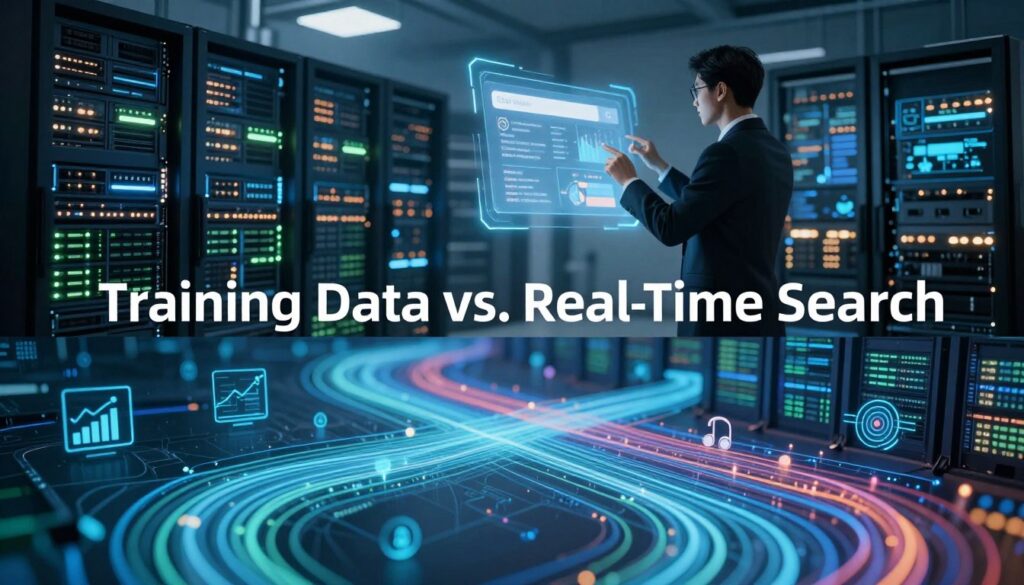
Sources for generated answers split into historical training sets and live retrieval from the web. Understanding this split explains why some brands show up often and others do not.
Training data and cutoff dates: why established brands often have an edge
Training data are large, historical corpora captured months before a model’s cutoff. That archive favors long-standing sites with many mentions and citations.
Cutoff dates matter because newer pricing pages, product launches, or local reviews may be missing from those sources.
Real-time search as the equalizer
Real-time retrieval pulls current pages and indexed sources. This helps startups, SaaS vendors, and India-based teams that publish fresh comparisons and pricing.
When engines fetch live content, recent updates can outrank legacy presence for time-sensitive queries.
What retrieval-heavy futures mean for optimization
Models that lean on live search raise the bar for consistent publishing, crawlability, and clear on-page structure.
- Practical takeaway: run repeatable content ops—updates, QA, and schema—so systems trust your information.
- Win both on-site quality and third-party mentions to influence what models retrieve.
“Sourcing is multi-channel: historical weight helps, but fresh, well-structured content wins where timeliness matters.”
AI Visibility Metrics That Matter More Than Traditional SEO KPIs
Traditional SEO numbers alone no longer explain how often systems mention your brand.
Track a compact KPI stack that reflects extraction and framing in generated responses. These metrics show whether engines pick your content as an answer source.
Core KPI stack
- Mentions — times the brand or product is named in responses.
- Citations — your URLs or pages cited as sources.
- AI share of voice — your share of answer recommendations versus competitors.
Why rankings and CTR fall short
Pages can be summarized inside answers without a click. That means ranking and click-through rate can stay the same while your presence in responses rises.
Interpret rank and traffic together with mentions and citations to understand real influence.
Impressions weighted by demand
No tool reports true LLM search volume. Use synthetic prompts plus weighting to estimate reach.
Treat these weighted impressions as conservative proxies. They show trends, not exact audience size.
Sentiment and context
Measure how responses frame your brand: premium, budget, beginner-friendly, or risky. Framing affects conversion quality.
Negative or incorrect context is a high-priority fix: update pages, add authoritative citations, and run outreach.
Reporting and operational use
Pair classic SEO metrics with the new stack for stakeholder reporting:
| Classic SEO | AI metrics | Action |
|---|---|---|
| Ranking | Mentions | Optimize extractable snippets and H2/H3 answers |
| Organic traffic | Citations | Strengthen on-page authority and schema |
| Bounce/conversion | AI share of voice & sentiment | Prioritize topics where SOV is low or sentiment is negative |
“Citations and positive framing often correlate with clearer on-page structure and stronger third-party authority.”
Attribution in AI: What You Can Measure and What You Can’t Yet
Mentions inside generated responses can seed demand that shows up elsewhere and later. That split between first contact and conversion breaks classic funnels. People may learn your brand from a short answer, then return via direct search, referral, or word-of-mouth. This makes linear attribution misleading.
Why awareness often misses standard analytics
Analytics tie sessions to the last click. If a user first encountered your product in a summarized response, that prior touch is invisible. Neutral or contextual mentions still shape perception and later choices.
What you can measure today
Measurable signals include referral traffic from known domains and on-site behavior that differs by source.
- Capture referrers from platforms and engines like chatgpt.com and perplexity.ai.
- Compare session length, pages per session, and conversion rates for those visitors.
- Run a short “How did you hear about us?” survey on key landing pages.
| Measurable | Method | Notes |
|---|---|---|
| Referrer traffic | Server logs & analytics | Shows direct links from extractor domains |
| On-site behavior | Segmented funnels | Highlights different user intent |
| Dark influence | Qual surveys | Captures mentions not in logs |
Practical, India-friendly tactic
Add a lightweight dropdown asking “How did you hear about us?” Include options for ChatGPT, Perplexity, Google AI Overviews, and word-of-mouth. Combine that qualitative data with referrer logs to estimate the unseen impact.
“Use referrer tracking plus surveys to surface the dark influence that plain analytics miss.”
Set expectations: treat mentions as a brand and demand-generation channel. Start with a baseline via controlled manual testing, then evolve your optimization and reporting strategy using both quantitative data and qualitative signals.
How to Baseline Your Current Visibility with Manual Testing
Begin with the exact phrases your customers type when they intend to buy or compare.
Collect high-intent prompts: “best…”, “how to choose…”, “X vs Y”, and budget or use-case variants.
Find the prompts to test
Pull query ideas from Google Search Console, keyword tools, People Also Ask, AlsoAsked, and sales or support FAQs.
Run and repeat across engines
Test each prompt on multiple engines to compare responses and sources. Rerun each prompt 2–3 times to capture variability.
Record a simple checklist
- Brand mentions and competitor inclusions
- Cited domains and cited URLs
- Recommended pages and page framing (context/sentiment)
- Prompt text, date, engine name/version, and screenshots
Document faithfully: store prompts, timestamps, and images for audits and later analysis.
| Step | What to capture | Why it matters |
|---|---|---|
| Prompt discovery | Query list from GSC, PAA, tools | Matches real customer language |
| Multi-engine tests | Responses & cited sources | Shows platform differences |
| Repeat runs | Stability of results | Estimates reliability of citations |
Limit: this manual method gives a solid baseline, but it does not scale for continuous monitoring or broad discovery.
Why Manual Tracking Breaks at Scale and What Automated Tools Add
Manual checks work for prototypes, but they collapse once you test hundreds of prompts across multiple systems.
Spreadsheets become brittle when prompts, platforms, and models shift. You can track a handful of high-value questions, but you will miss the long tail of queries that drive mentions and citations.
Discovery vs. tracking
Tracking verifies known prompts and records changes over time. Discovery finds the questions and topics you never thought to test.
Automated tools scan large prompt sets and surface gaps where your brand or content is absent. They also reveal competitor mentions you did not know existed.
Consistency and operational value
Weekly or monthly monitoring catches shifts after model updates or new campaigns. Tools provide trend lines, alerts, and segment filters by persona, region, or topic.
- Scale: track thousands of prompts across engines and platforms.
- Reliability: avoid debates over a single screenshot with repeatable logs.
- Actionable insights: turn alerts into content updates, new pages, or outreach.
“Automation produces repeatable reporting and frees teams to execute optimization and outreach.”
| Problem | What tools add | Outcome |
|---|---|---|
| Limited prompt set | Discovery of unknown questions | Broader presence checks |
| Irregular checks | Scheduled runs and trend alerts | Faster response to model or engine shifts |
| Manual debates | Evidence logs and exports | Stakeholder buy-in and repeatable reporting |
AI Visibility Tools: What to Look for Before You Buy
Choose a tool that matches whether you need SERP-based monitoring or conversational prompt tracking.
Answer-engine monitoring vs. chatbot prompt tracking
Answer-engine monitoring watches search-integrated results like Google AIO or Bing chat. It captures which sites are cited on result pages.
Chatbot prompt tracking replays conversational prompts for models such as ChatGPT or Perplexity. It records responses and the sources cited inside those replies.
Evidence logs and screenshots for audits and stakeholder reporting
Evidence logs with time-stamped screenshots reduce disputes and speed audits. Ask for raw response capture plus exportable attachments for client reports.
API access and exports for dashboards, workflows, and cross-channel reporting
APIs let you pipe data into Looker Studio or Power BI. Exports are essential for teams that blend search engines metrics with product analytics.
Competitive benchmarking and methodology
Compare share-of-voice, prompt-level winners, and domains that appear most often. Verify whether prompts are synthetic, how often data refreshes, and how tools handle response variability.
| Feature | Why it matters | What to ask | Best for |
|---|---|---|---|
| Evidence logs | Audit trail for results | Screenshots, raw text, timestamps | Agencies, compliance teams |
| API & exports | Dashboards and automation | REST endpoints, CSV/JSON export | Growth teams, startups |
| Benchmarking | Competitive gaps and SOV | Prompt-level comparison, domain ranks | Product owners, SEOs |
| Methodology | Data quality | Synthetic prompts, refresh cadence, sampling | Enterprises, research teams |
Selection tip: startups often need fast exports and clear signals; enterprises need scale, access control, and compliance features.
Choosing the Right AI Visibility Tool for Your Team Size and Budget
Start by defining whether you need brand-level share metrics, prompt-level control, or prescriptive audits.

Decision tree: if you want broad trend monitoring and gap analysis, pick a brand-focused product. If you need rapid multi-engine dashboards for marketing, choose a mid-market option. For strict compliance, deep segmentation, and enterprise workflows, choose a platform built for scale.
Brand Radar (Ahrefs Brand Radar)
Positioning: broad index coverage, share of voice, and gap analysis for discovering prompts and topics where competitors appear.
Price: included with Ahrefs from $129/mo. Good for teams that already use Ahrefs and need wide data and export options.
SE Visible and Peec AI
Both offer fast multi-engine dashboards for marketers who want clarity on presence and competitor standing.
Peec AI is cost-effective (€89/mo) and suits small teams. SE Visible (~$189/mo) fits agencies needing ready dashboards and sentiment/context tracking.
Profound and Scrunch
Enterprise-grade monitoring, compliance features, and deep segmentation. These platforms scale for large sites and strict workflows.
Profound starts at $399/mo; Scrunch around $300/mo. Choose these when audits, role controls, and long-tail segmentation matter.
Otterly AI, Writesonic GEO, and Rankscale AI
Otterly AI ($29/mo) and Writesonic GEO ($249/mo) add prescriptive audits and readiness recommendations when teams want fixes, not just signals.
Rankscale ($20/mo) is a budget option for page-level citation visibility and validating whether specific URLs get referenced by engines.
Procurement guidance: verify data freshness, export/APIs, evidence logging, and regional platform support before committing.
| Tool | Typical Price | Best for | Key capability |
|---|---|---|---|
| Ahrefs Brand Radar | $129+/mo | Hands-on SEO teams | Share of voice, gap analysis, broad index |
| SE Visible | $189/mo | Agencies & marketers | Multi-engine dashboards, sentiment |
| Peec AI | €89/mo | Small teams | Competitive presence, exports |
| Profound | $399/mo | Enterprises | Compliance, deep segmentation |
GEO, LLMO, and AEO: The Optimization Mindset Behind AI Visibility
Think of GEO, LLMO, and AEO as overlapping layers that help systems pick which brands to name inside compact answers.
Definition: These terms focus on inclusion and recommendation inside ai-generated answers, not only SERP ranking. Each layer favors clear entity signals and repeatable proof from multiple sources.
Earning mentions, not just rankings
Third-party validation often outperforms self-published claims. Language models and retrieval systems weigh consensus and independent citations when selecting sources.
Practice: secure mentions on trusted industry lists, reviews, and data studies. Those external signals increase the chance your brand is chosen.
What still carries over from traditional SEO fundamentals
Crawlability, internal linking, metadata, topical authority, and backlinks remain foundational for engine optimization and long-term success.
What changes is the unit of optimization: write modular, extractable content blocks and ensure consistent entity details across the web.
| Focus | Traditional strength | New emphasis |
|---|---|---|
| Content | Depth and ranking | Snippable, modular answers |
| Authority | Backlinks, PR | Third-party mentions, consensus |
| Technical | Crawl & index | Consistent entity signals, structured data |
“Treat recommendation systems as a layer on top of search—align SEO, content, PR, and product so systems find the same facts to cite.”
Content That Wins AI Citations: Formats, Freshness, and Authority Signals
Original data and clear methodology make a page citable and trusted. When you publish numbers and a transparent method, search systems and models can point to concrete evidence rather than opinion.
- “Best” lists: quick recommendations that match recommendation prompts.
- Comparisons: side-by-side facts for decision prompts.
- How-tos and FAQs: troubleshooting and definition prompts.
- Product pages: factual blocks—what it is, who it’s for, key features.
- Data studies: original numbers with method sections that act as authority signals.
For lists and comparisons, use explicit criteria and short summaries. That makes it easy for an answer to lift a single sentence as a concise response.
Write in modular blocks: clear headings, short paragraphs, bullet lists and tables. Models parse pages into chunks; extractable blocks win citations more often.
“Track which formats earn citations and double down on the ones that match your highest-intent prompts.”
| Format | Why engines cite it | Action |
|---|---|---|
| Best lists | Direct recommendations | State criteria and score |
| Data studies | Concrete numbers | Add methods and charts |
| Product pages | Factual blocks | Highlight specs and use cases |
On-Page Structure and Schema Markup for AI-Readable Content
Well-structured pages let automated responders find and reuse your facts as concise replies. Clear on-page signals are ranking inputs, not decoration.
How readability works in practice
Assistants parse pages into modular chunks and extract snippable lines. Good formatting increases the chance your content is lifted as a direct answer.
Snippability checklist
- Direct answer: 1–2 sentence lead that answers the query.
- Short paragraphs (1–3 sentences).
- Bulleted lists and numbered steps for procedures.
- Comparison tables for side-by-side facts.
Heading hierarchy
Use H2s and H3s to isolate single ideas. One idea per heading ensures extractors do not mix concepts when assembling responses.
Schema and implementation notes
Priorities: FAQPage, Product, and Review schema. Add schema markup in JSON-LD via your CMS or with developer support. Keep markup consistent with visible page content.
Common blockers and quality control
Avoid robots.txt blocks, content hidden in tabs that may not render, PDFs as primary pages, and key text in images.
Test crawlability, rendering, and that critical facts exist in HTML with clear labels and context.
“Make extractable facts obvious: structure, schema, and clean headings do the heavy lifting.”
| Element | Why it matters | Action |
|---|---|---|
| Direct answer | Can be lifted as a snippet | Add a 1–2 sentence summary at top |
| Schema | Classifies content for engines | Implement FAQPage/Product/Review JSON-LD |
| Rendering | Ensures extractors read content | Audit tabs, PDFs, images, and robots rules |
Off-Site Presence: How to Get Cited Where AI Already Looks
Third-party signals often determine which brands are chosen in summarised answers, so your outreach matters as much as on-site work.
Why off-site sources matter more than your own domain: recommendation systems and search engines weigh independent mentions and consensus. A brand cited on reputable lists, reviews, or trade sites gains authority that a self-published page seldom matches.
Focus outreach on high-leverage targets that regularly appear as trusted sources.
High-priority outreach targets
- Industry “best of” and ranking pages that compile options for buyers.
- Comparison sites and review platforms where users and editors evaluate products.
- Trade publications and news media with topical relevance in India and global markets.
- Partner ecosystems and case-study pages from customers and integrators.
- YouTube explainers and long-form reviews that search engines and systems surface for how-to prompts.
How to earn ethical citations
Contribute expert quotes to reporters, publish transparent data and methods, and make customer case studies easy to reference. Provide clear product documentation and permissive assets (facts, charts) that publishers can lift without friction.
India-specific PR tip: pitch both national outlets (Economic Times, Mint, YourStory) and niche trade sites. Use consistent brand naming and structured bios to reduce entity confusion across sources.
Platform-led discovery
Participate in relevant Reddit threads and support evergreen YouTube explainers. Both platforms influence perception and can be surfaced in summary responses depending on the engine and the prompt.
Build an earned-mentions pipeline
Create a monthly target list, craft short pitch angles, prepare proof assets (data, screenshots, customer quotes), and track placements. Prioritise domains that repeatedly appear as sources in your niche.
| Target | Why it matters | First action |
|---|---|---|
| Industry “best of” lists | Frequently cited by systems as recommendation sources | Offer data-backed entries and exclusive quotes |
| Review sites & comparison platforms | User trust and structured comparisons | Encourage verified reviews and supply comparison sheets |
| Trade press & local media | Regional authority and broad reach | Pitch newsworthy angles and local case studies |
| YouTube & Reddit | Platform-led discovery and community validation | Support creators with demos and answer thread FAQs |
“Third-party sources shape how systems frame and recommend brands; earn those mentions with data, transparency, and repeatable outreach.”
Competitive Advantage: Finding AI Mention Gaps and AI Citation Gaps
Finding the prompts that name rivals — while leaving you out — reveals clear growth targets.
AI mention gaps are prompts where competitors appear in answers or lists and your brand is missing. These are unclaimed slots you can win with targeted content or outreach.
AI citation gaps occur when engines cite competitor URLs—guides, listicles, or studies—instead of your pages. That shows missing proof or weaker on-page data that needs fixing.
Turn gaps into an action plan
Prioritise prompts with clear commercial intent, high competitive presence, and alignment to your product positioning. Use tools to surface prompt frequency and which platforms or engines cite rivals most.
Typical tactical plays:
- Publish a definitive comparison page or refresh an outdated pricing/features block.
- Add an original data study or method section so your page becomes a citable source.
- Run targeted outreach to earn placements on third-party “best of” lists and review sites.
| Gap | Action | Owner & KPI |
|---|---|---|
| Mention gap | Create comparison content + internal links | Content team — mentions up |
| Citation gap | Publish data study & PR pitch | PR — citations secured |
| Technical gap | Schema, snippable leads, render checks | SEO — extraction rate |
Report outcomes by showing pre/post changes in mentions, citations, and context framing across platforms. Emphasise improved authority and results, not just clicks, to prove strategy success.
Conclusion
Brands must compete to be the referenced source when systems craft short, decision-ready replies.
AI referrals to top sites grew 357% year‑over‑year to 1.13 billion visits in June 2025. That shift makes selection inside answers as important as blue‑link rank for long‑term growth.
Your priorities are simple: pick the platforms that matter, baseline current presence, and measure mentions, citations, and share of voice before making large bets.
The operating system that wins blends strong traditional seo, modular content, practical schema, and frequent freshness. Off‑site authority and trusted sources often decide who gets cited.
Next step: run a manual baseline this week, list top gaps, then pick a monitoring tool for competitive benchmarking and repeatable optimization.